
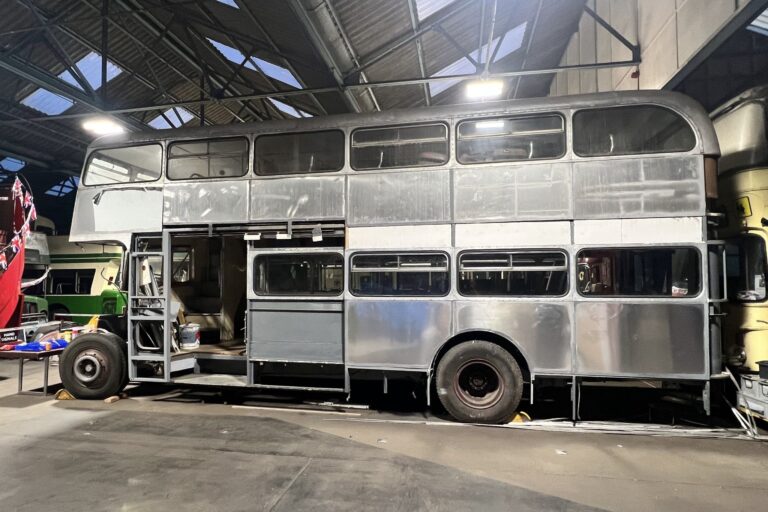
80 80 NVO
New To: South Notts
Chassis: Leyland Titan PD3/4 620171
Body: Northern Counties 5766 L33/32F
Status: Undergoing Restoration
Delivered in 1962 to Gotham-based operator South Notts, 80 was the last bus ordered by this operator with an exposed front radiator. By the early 1960s, front-engined double deckers were rapidly being superseded by rear-engined and cladded radiator designs, making 80 something of a traditionalist even when new. It has a body seating 33 passengers upstairs and 32 downstairs, providing a total capacity of 65 passengers — well suited to the busy commuter and rural services operated by the company.
It was built to a low bridge layout, which meant that the upper deck seats are arranged in rows of four, with a sunken gangway running down the offside. This distinctive configuration allowed the overall vehicle height to be reduced without drastically compromising seating capacity. The reason for South Notts buying buses with this layout, which had a lower overall height as a result, was the 13’ 6” Great Central Railway bridge on Wilford Lane. This low bridge presented a permanent operating constraint, and vehicles exceeding the height restriction would have been unable to serve key routes. The low bridge design therefore represented a practical engineering solution to a local infrastructure challenge, and became a defining feature of the South Notts fleet.
80 operated on South Notts routes until it was withdrawn from service in March 1984, giving it an impressive 22 years of frontline duty. By the time of its withdrawal it was the longest-serving front-engined bus in the fleet. Throughout its working life it would have been a familiar sight on services linking Gotham and surrounding villages with Nottingham, carrying generations of passengers to work, school and leisure activities.
As was the way with South Notts, the bus was not sold on immediately following withdrawal, but instead parked up at the rear of the depot along with many other redundant vehicles. This informal storage practice, while unremarkable at the time, ultimately played a crucial role in the preservation of several historically significant vehicles, as it spared them from immediate disposal.
Subsequently, 80 was privately licensed in 1985 and began attending a number of rallies, marking its transition from everyday service vehicle to preservation exhibit. Just prior to South Notts being acquired by Nottingham City Transport, 80 was purchased from the company by Arthur Dabell — the owner of South Notts — ensuring that it remained in sympathetic hands during a period of organisational change. The bus was then placed under the care of the Nottingham Transport Heritage Centre at Ruddington, where it formed part of a growing collection of local vehicles.
In March 2007, the Dabell family decided to donate the bus to Nottingham Heritage Vehicles (the predecessor to NHVC) following the arson attack that happened at Ruddington. This generous decision ensured the vehicle’s long-term survival at a time when several preserved vehicles were at risk. Since then, the bus has been undergoing an extensive restoration, a process involving careful structural, mechanical and cosmetic work to return it as closely as possible to its original 1962 South Notts condition.
Today, 80 represents not only the final example of a particular South Notts design choice, but also a tangible link to the operational challenges posed by local infrastructure such as the Wilford Lane bridge. Its continued restoration ensures that this distinctive low-bridge, front-engined double decker will remain an important part of Nottinghamshire’s transport heritage for years to come.


