
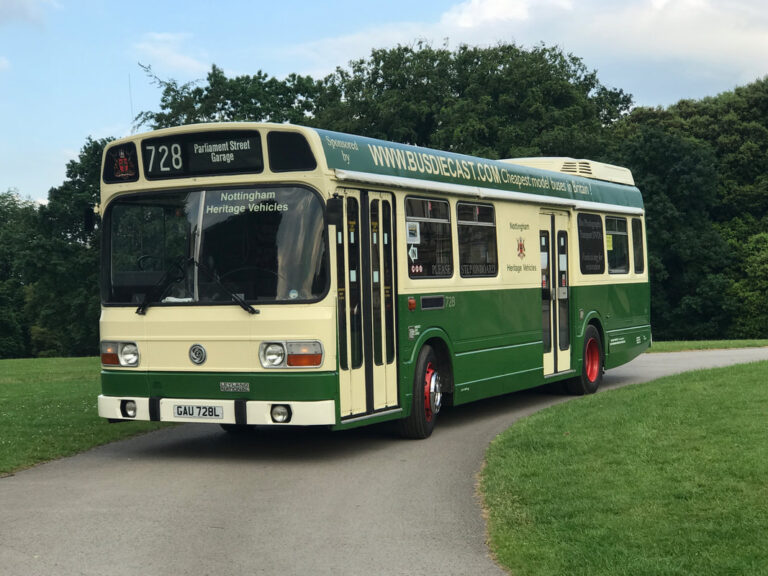
728 GAU 728L
New To: Nottingham City Transport
Chassis: Leyland National 1051/2R/0101 00812
Body: Integral B44D
Delivered in 1973 to Nottingham City Transport as part of a batch of eight similar vehicles, 728 is a first-generation Leyland National supplied with a 44-seat dual-door layout. It was specifically ordered for operation on the Central Area Service, Route 77 — a circular route linking key points around Nottingham city centre including the Victoria Centre, the former Broadmarsh Shopping Centre, Mount Street Bus Station and The General Hospital, via the Market Square.
The Leyland National was introduced in 1972 as a joint venture between Leyland Bus and the National Bus Company and was constructed at the purpose-built factory at Workington, Cumbria. It was designed as a fully integral vehicle, meaning the body and chassis formed a single structure. The design focused heavily on standardisation and modular construction, allowing damaged panels to be removed and replaced quickly, reducing downtime and simplifying maintenance. Between 1972 and 1985, more than 7,000 examples were produced, making it one of the most numerous British single-deck bus types of the era.
The National was built in two standard lengths — 10.3 metres and 11.3 metres — and could be specified with either single or dual doors depending on operational requirements. Mark I examples, such as 728, were fitted with the Leyland O.510 engine mounted at the rear and featured the distinctive roof-mounted heating pod at the back of the vehicle. Their clean styling and standardised window layout made them instantly recognisable and marked a clear break from traditional body-on-chassis bus construction.
Route 77 was easily identifiable by its distinctive yellow roof and front panel, while the companion Route 88 carried an orange roof and front panel. This colour-coding provided clear visual differentiation in the busy city centre environment. After several years, however, the coloured roof policy was discontinued and the roofs were repainted, allowing vehicles greater flexibility to operate on either route. In 1978, 728 received a striking all-over advertisement livery for Grays Television of Bulwell.
Following withdrawal from normal passenger service, 728 was given a new lease of life as a mobile sales unit situated in the Market Square to promote the then-new Easyrider travel card scheme. By 1986 it was stored at Trent Bridge, by which time NCT had acquired permanent shop premises in the Market Square. In June 1988, the vehicle was sold to West Midlands Passenger Transport Executive, where it undertook promotional duties connected with the proposed Midland Metro tramway project.
In the West Midlands it ultimately became a static promotional vehicle, finished in bright yellow with “Centro” branding — Centro being the operating arm of the PTE — and was primarily used as a mobile information and timetable display unit.
In August 2002, 728 was acquired by Nottingham Heritage Vehicles. During the winter of 2002/3, the interior was modified for use as a photo sales and display unit, while externally the bus was rebuilt and repainted into its original Nottingham livery. Since then, it has been repainted into several versions of the classic ‘Standard’ NCT green and cream and continues to attend rallies and events around the country.


