
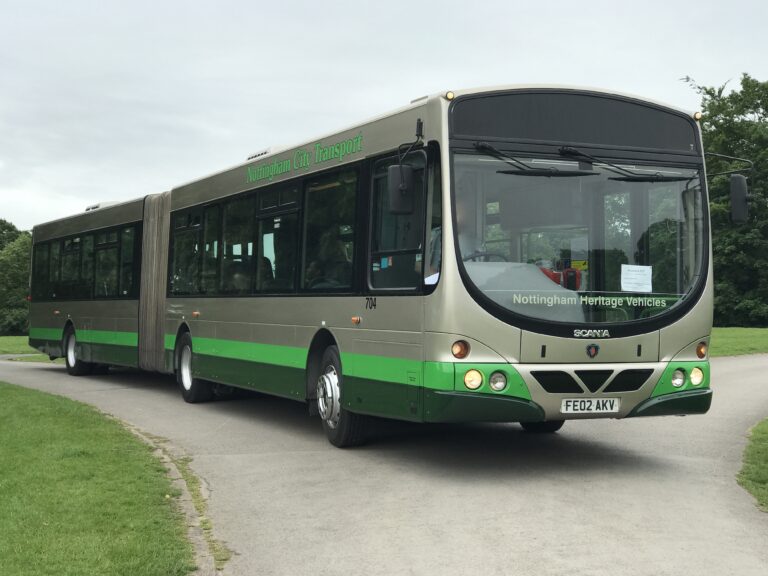
704 FE02 AKV
New To: Nottingham City Transport
Chassis: Scania L94UA YS4L6X20001841182
Body: Wright Solar Fusion E314 AB59D
Delivered in March 2002, 704 entered service with Nottingham City Transport as one of a batch of five articulated vehicles built on the Scania L94UA chassis. It was delivered in the then-new GO2 Lime Line livery for Service 58 between Nottingham City Centre and Arnold, marking a bold and highly visible investment in high-capacity bus operation within the city.
According to John Lowrie, the former Engineering Director who placed the order, “the bendy buses were ordered to show Nottingham City Council there was an alternative to a tram network.” The articulated design allowed for substantial passenger capacity, with 59 seated passengers and a total licensed capacity of up to 146 including standing passengers. This made them ideally suited to busy urban corridors where demand was high but fixed rail infrastructure had yet to be implemented.
Vehicles 702, 703, 704 and 705 were delivered new for Route 58 to Arnold, while 701 arrived in the livery 704 carries today. In later years, 701 and 705 transferred to Navy Line 48, before the entire articulated fleet moved onto the dedicated Nottingham Trent University campus-to-campus service, Unilink 4. This later became GO2 Uni Navy Line 4, operating from the City Centre Campus via the Railway Station, Trent Bridge and Wilford to the Clifton Campus. During their time on the Unilink services, the bendy buses were based at Gotham Depot. Over time, they became something of an icon within Nottingham City Centre, instantly recognisable due to their length and distinctive appearance.
The end of the road for the articulated fleet came in June 2014. They were replaced in August 2014 by 2005-built Scania Omnidekkas ahead of the new academic term, bringing an end to over a decade of bendy bus operation in Nottingham.
Today, 704 is the only surviving mechanically complete example from the Nottingham articulated fleet. All the others, with the exception of 702, were stripped of useful components by NCT before being scrapped. 703 was sent to Barnsley for disposal, while the remainder — including 700, the former Lothian and ex-London Omnicity-bodied demonstrator — were broken up at Langar Airfield. Vehicle 702 survives in a very different form, having been converted by the Territorial Army for use as a library within a school in Chilwell, with £40,000 of MOD funding supporting the project. However, it no longer retains its engine or gearbox.
In August 2014, 704 joined the charity, purchased for a nominal sum after Nottingham City Transport had removed the seats, destination equipment and CCTV. As the intended preservation use did not require these items to remain in situ, their removal did not deter the acquisition, and appreciation is extended to NCT for recognising the significance of preserving one of the vehicles. The original intention had been to secure demonstrator 701 (Y701 LRB), but NCT required the gearbox from that vehicle and others; by modifying part of the casing, these gearboxes could be utilised in the Scania Omnidekka fleet. As 704 and 705 were fitted with uprated engines and gearboxes, this was not possible in their case, aiding 704’s survival. Although 705 was inspected prior to acquisition, it displayed significant front-end bodywork crazing following an earlier road traffic collision, making 704 the preferable candidate.
Since arrival into preservation, considerable work has been undertaken. Internal handrails were removed, most vinyl advertisements stripped out, and substantial work carried out to the lighting system due to missing inverters and inoperative wiring. It quickly became apparent that the vehicle required significant mechanical investment. A power steering pipe had been rubbing against the chassis frame to the rear of the articulation coupling, necessitating full replacement from the coupling joint to the rear of the vehicle. Seven of the ten suspension airbags have been replaced, along with rectification of numerous smaller faults.
In June 2015, following completion of this work and reticketing, 704 successfully returned to the road. Special thanks are due to Wrightbus for supplying manuals and service documentation after local copies could not be located. It is disappointing that none of the five original handbook sets supplied to NCT with the fleet appear to have survived. More recently, the original seating has been generously donated back by NCT and refitted, along with the correct handpoles, further restoring 704 to its authentic in-service condition.
As the sole mechanically complete survivor of Nottingham’s bendy bus era, 704 represents a significant and highly distinctive chapter in the city’s modern transport history.


