
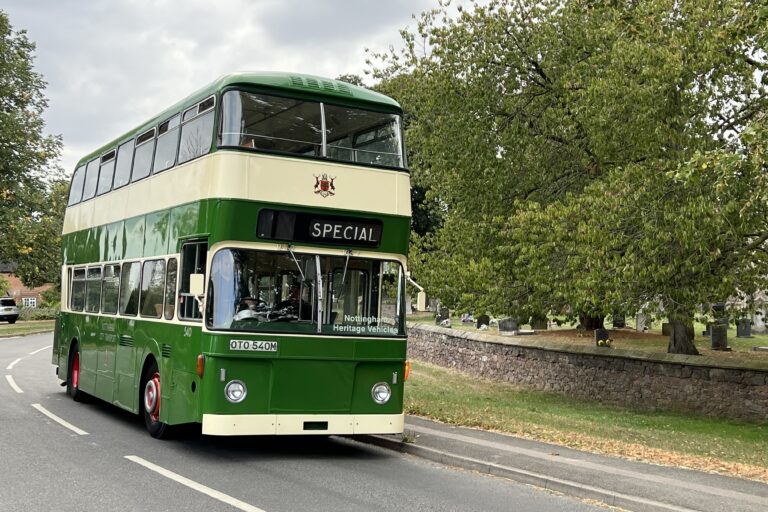
540 OTO 540M
New To: Nottingham City Transport
Chassis: Leyland Atlantean AN68/1R 7302378
Body: East Lancs 2501 H47/30D
Delivered in December 1973 to Nottingham City Transport as part of a batch of 46 identical vehicles, fleet number 540 is fitted with an East Lancashire Coachbuilders double-deck body, seating a total of 77 passengers — 47 on the upper deck and 30 on the lower saloon. It was the very first Leyland Atlantean AN68 delivered to Nottingham, marking the beginning of what would become one of the most numerous and recognisable bus types in the city’s history. Nottingham ultimately purchased over 230 AN68s before production ceased in 1984, underlining the operator’s confidence in the type.
The AN68 itself was an improved development of the earlier Atlantean models, incorporating refinements to address mechanical and structural issues identified in previous variants. These improvements enhanced reliability, ride quality and maintenance access, making the chassis particularly well suited to intensive urban operation. For Nottingham, the type became synonymous with the city’s bus network throughout the 1970s and 1980s.
Vehicle 540 was constructed to the distinctive “Nottingham Standard” specification, a locally developed design concept that gave Nottingham’s fleet a strong and consistent visual identity for many years. The Nottingham Standard incorporated numerous practical and aesthetic features, including an angled destination display for improved visibility in busy city streets, higher internal ceilings for greater passenger comfort, a substantial front bumper to reduce accident damage, elegant curved upper deck front windows, and curved windscreens that enhanced both appearance and driver visibility. A high degree of component standardisation across the fleet also simplified engineering and reduced maintenance costs.
540, along with a small number of others from the batch, was among the final vehicles in the fleet to carry the traditional gold company fleet names — a finishing touch that linked it visually with earlier generations of Nottingham buses.
The bus entered service on 10 December 1973 from Trent Bridge Garage, where it would spend the majority of its working life. It became a familiar sight on West Bridgford routes and other services operating south of the River Trent, carrying thousands of passengers during its front-line career. In 1979 it was repainted into the dual green band livery, while notably retaining its gold fleet numbers. Further repaints followed in 1982 and 1986, reflecting evolving corporate presentation while the vehicle continued to provide reliable service.
In 1989, after sixteen years of operation, 540 was withdrawn from service and placed into storage at Trent Buses’ Manvers Street depot, later moving to Bulwell Depot. However, its working life was not yet over. On 1 September 1989 it was relicensed and briefly returned to service from Trent Bridge Garage before its final withdrawal later that year. It was subsequently sold to Confidence of Oadby, where it became fleet number 20. For almost twelve years the bus operated on school contracts and private hire work around the Leicester area, demonstrating the durability of both the AN68 chassis and its East Lancs body.
In February 2001, 540 was acquired for preservation by Nottingham Heritage Vehicles, ensuring that this historically significant example of the city’s first AN68 would be saved. The vehicle remained in storage until May 2004, when a comprehensive restoration programme began. The restoration involved extensive mechanical overhaul and bodywork rebuilding, returning the bus to its original 1973 specification. By August 2005, 540 had been fully repainted into its original Nottingham City Transport livery, once again carrying the gold fleet names and presenting an authentic appearance representative of the early 1970s fleet.
Today, 540 stands not only as the first AN68 delivered to Nottingham, but also as a tangible reminder of an era when the Leyland Atlantean formed the backbone of the city’s bus services.


