
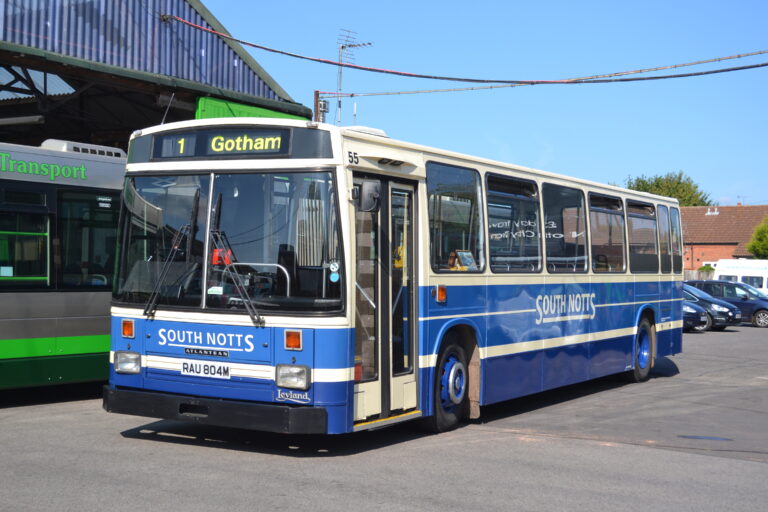
55 RAU804M / 555 OTO555M
New To: Nottingham City Transport/South Notts
Chassis: Leyland Atlantean AN68/1R 7304429
Old Body: East Lancs 2516 H47/30D
Current Body: East Lancs B5201 B45F
Delivered in January 1974, 555 entered service with Nottingham City Transport as one of a batch of forty similar vehicles. It was fitted with an East Lancashire Coachbuilders double-deck body, seating 77 passengers — 47 in the upper saloon and 30 in the lower saloon. As built, it represented the standard double-deck fleet type of the mid-1970s and went on to give nearly two decades of service in Nottingham.
By the end of 1992, many vehicles of similar age were approaching the end of their operational lives. Rather than dispose of them outright, NCT explored the possibility of extending their usefulness through rebuilding. East Lancs had already successfully converted a number of life-expired double-deckers into single-deckers for other operators, and 555 was selected to undergo the same process.
In February 1993, 555 was dispatched to East Lancs for conversion. Its original double-deck body was removed and the chassis comprehensively overhauled. To make the project viable, the wheelbase was lengthened by approximately four feet. Had the chassis remained at its original length, the resulting single-decker would have seated only 33 passengers — insufficient for the intended duties. With the extension, seating capacity increased to 45 passengers, and a luggage rack was incorporated over the nearside front wheel arch to enhance its suitability for longer-distance work.
In its rebodied form, however, 555 developed certain manoeuvrability issues. These related primarily to steering lock. As a double-decker, the original chassis had been shorter and therefore required less steering angle. Once lengthened into a single-deck configuration, it retained double-deck steering geometry, which was not ideally suited to the longer wheelbase. Fortunately, 555 was fitted with the “World Master” front axle, which helped mitigate what could otherwise have been more serious handling limitations.
Upon completion, 555 returned to Nottingham and was repainted at Trent Bridge Works into South Notts livery. It was renumbered 55 and entered service on 31st March 1994, allocated to Gotham Garage. From here it operated primarily on Service 1 between Nottingham and Loughborough via Clifton, Gotham, East Leake and Stanford on Soar. Despite its intended role, 55 was never particularly popular with drivers. The ride was described as bouncy, largely because the vehicle retained double-decker-rated springs without the corresponding weight of a full upper saloon. As a result, the original ambition to convert around forty vehicles was abandoned, and 55 remained a unique one-off within the fleet.
Following withdrawal from NCT service, 55 passed to Hulleys of Baslow, who operated it in a similar livery, although the lighter upper blue was replaced with the same darker shade used on the skirt. After its time with Hulleys, 55 entered preservation with J. Lilley. During this period it was stored at Bowers and saw occasional further use in service. It later moved to Shamrock and Rambler in Dorset, from where Nottingham Heritage Vehicles — predecessor to NHVC — acquired it for the first time.
Back in preservation, 55 received a full restoration into South Notts livery. In 2010 it was sold to a private preservationist in the West Midlands, who retained it until 2020, when it changed hands again. In February 2023, Adam was offered the opportunity to bring 55 back into the collection. The chance could not be missed, and in March it returned home from a semi-scrapyard in Herefordshire by suspended tow.
Sadly, 55 was in a far poorer condition than when it had originally left the collection. It arrived as a non-runner, but after two solid days of determined work and the fitting of numerous replacement parts, the engine finally fired into life for the first time in a few years. More recently, the vehicle has been undergoing a comprehensive rebuild. Much of the chassis has been stripped back to bare metal, treated and repainted, with numerous components removed, overhauled and refitted — and the remainder will follow in due course. Externally, every body panel has been removed, structural framework replaced where necessary, and new panels fabricated and installed. The front step area has been completely rebuilt with new framework and fresh plywood flooring. Mechanically, the Leyland 680 engine has received significant attention, including a refurbished fuel pump and new injectors. Progress is moving steadily forward, and the project is currently on track for completion later this year (2026).


