
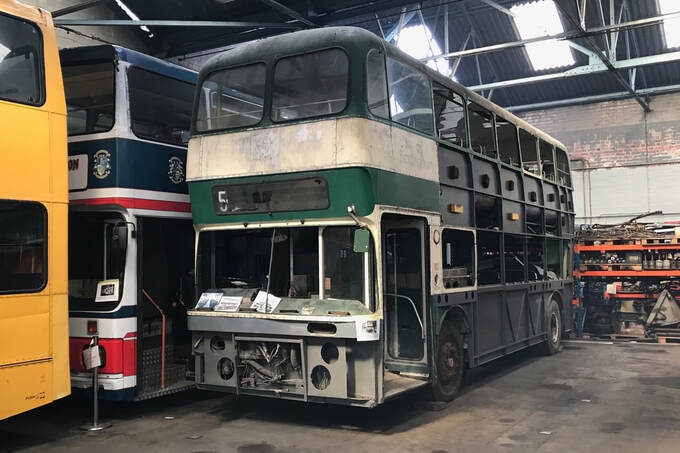
452 ETO452C
New To: Nottingham City Transport
Chassis: Leyland Atlantean PDR1/2 L40453
Body: Metro Cammell H45/31F
Status: Awaiting Restoration
Delivered in October 1965 as part of a batch of 40 similar vehicles, 452 is a Leyland Atlantean fitted with a Metro-Cammell double-deck body. As originally constructed, it seated a total of 76 passengers — 45 in the upper saloon and 31 in the lower saloon — and was built with a single front entrance and exit. This layout reflected early rear-engined double-deck practice in Nottingham, preceding the widespread adoption of dual-door configurations that became common on later Atlanteans delivered to Nottingham City Transport.
At the time of its delivery, 452 formed part of a significant phase of fleet modernisation. Rear-engined double-deckers represented a major step forward in passenger comfort, offering quieter operation, improved heating, and a smoother ride compared with the front-engined buses they replaced. The Metro-Cammell bodywork combined practicality with a clean, modern appearance that would soon evolve into one of Nottingham’s most recognisable fleet styles.
In February 1971, after just over five years in service, 452 underwent a comprehensive rebuild by Seddon Diesel Vehicles (rebuild no. RB848). The vehicle was converted to H45/27D configuration, reducing seating capacity to 72 passengers and incorporating a dual-door layout. This alteration was carried out to improve passenger flow on busy city routes and to align the vehicle more closely with contemporary operational requirements, extending its useful service life.
Vehicle 452 represents an early example of what became known as the “Nottingham Standard” design — a distinctive and highly influential styling concept that defined Nottingham’s buses for many years. The Nottingham Standard incorporated several notable features, including an angled destination display for improved legibility, higher internal ceilings that created a brighter and more spacious interior, curved windscreens that enhanced both appearance and driver visibility, and a high degree of standardisation of components to simplify maintenance. Today, 452 is the earliest surviving example of the Nottingham Standard design, giving it particular historical and heritage significance within the city’s transport story.
The bus operated in Nottingham for more than 15 years, serving a wide variety of city routes and becoming a familiar sight to generations of passengers. In March 1981, following the imminent arrival of a new batch of Leyland AN68 vehicles, it was renumbered 52 and spent its final months in service as a driver training vehicle before withdrawal in May 1981.
After withdrawal, the vehicle was stored at Parliament Street depot and sold on 15th May 1981 to Smiths of Alcester, near Stratford-upon-Avon, for £650 plus VAT, being collected on 29th May 1981. By September 1985 it had passed to the Home Office for use by the Fire Service at the training college at Moreton-in-Marsh, where it remained operational for over a decade. Despite its training role, much of the main structure survived in sound condition, enabling its later acquisition for preservation.
Since acquisition, substantial restoration has been undertaken. The roof structure has been rebuilt where required, lower saloon panels removed to replace steel floor rails and side structure members, and the lower saloon floor lifted to facilitate this work. During the rebuilding process, the vehicle has been returned to its original 1965 single front-entrance layout, reinstating its authentic early Nottingham Standard appearance.


